

February 1 2026
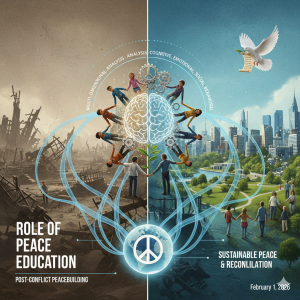
Role of Peace Education in Post-Conflict Peacebuilding: A Multi-Dimensional Analysis
Prof. Said Abubakar, Febrruary,1, 2026
The scholarly literature consistently underscores the indispensable function of peace education as a foundational pillar for sustainable peacebuilding in societies emerging from violent conflict. This commentary synthesizes key theoretical and empirical insights, arguing that education operates not as a singular intervention but as a multi-faceted ecosystem crucial for reconciliation, social reconstruction, and the prevention of conflict relapse.
A primary contribution of peace education is its capacity to navigate the complex interplay between justice and reconciliation. As Pankhurst (1999) elucidates, post-conflict periods are characterized by “complex political emergencies” where the pursuit of justice and the need for societal healing must be carefully balanced. While formal judicial mechanisms, often supported by external actors, address accountability, reconciliation is fundamentally an endogenous process. International actors thus play a supportive, rather than directive, role in fostering the conditions for internal healing (Pankhurst, 1999). Education systems become critical spaces where this support is operationalized, helping to process collective trauma and foster a shared narrative.
In the practical task of reconstructing a shattered civil society, education is the primary vehicle for instilling the norms essential for a democratic and peaceful polity. Davies (2004) argues that post-conflict education must transcend basic literacy to actively “build a civic culture” through deliberate instruction in legal awareness, human rights, and citizenship. These educational domains are instrumental in rebuilding eroded trust, fostering participatory governance, and promoting social accountability—cornerstones without which a technical peace agreement remains fragile (Davies, 2004). This aligns with the critical question posed by Carr and Porfilio (2012), who challenge the assumption that education is inherently a force for good. They contend that in contexts of conflict, educational institutions and their curricula can either perpetuate divisive ideologies or serve as transformative platforms for peace, depending on their design and implementation (Carr & Porfilio, 2012).
The transformative potential of education is significantly amplified when it actively includes marginalized voices. Mojab’s (2008) analysis emphasizes the pivotal, yet often overlooked, role of women’s learning and knowledge in conflict prevention and peacebuilding. Inclusive educational research and practice that centralize the experiences of women and other marginalized groups are vital for developing holistic and effective peacebuilding strategies (Mojab, 2008). This is empirically demonstrated in the post-conflict context of Bosnia and Herzegovina, where Jelešković and Mulalić (2022) document how female academics act as key agents in peacebuilding and state-building. Through their academic work and societal engagement, these professionals advance gender-sensitive approaches and promote social cohesion, thereby addressing structural inequalities that fuel conflict (Jelešković & Mulalić, 2022).
Beyond formal schooling, the ecosystem of peace education includes higher education and civil society. A case study from Khyber Pakhtunkhwa illustrates that strategic policy in higher education can directly contribute to violence reduction. Shahab and Ullah (2021) found that expanding access to higher education and aligning its goals with community peacebuilding enabled youth to engage in productive civic life, acting as a “catalyst for peace” (Shahab & Ullah, 2021). Furthermore, non-governmental organizations (NGOs) fill crucial gaps in this ecosystem. As Carey (2017) discusses, NGOs often act as subcontractors of peace, implementing on-the-ground initiatives for social stabilization, community dialogue, trauma management, and local institution-building—functions essential for translating national-level peace into local reality (Carey, 2017).
Based on the synthesized literature, actionable recommendations for Somalia to leverage peace education as a catalyst for sustainable peacebuilding include several interconnected strategies. First, the Federal Ministry of Education, Culture & Higher Education should collaborate with regional states to revise national curricula from primary to secondary levels, incorporating mandatory, context-specific modules on peacebuilding, human rights, civic education, and conflict resolution. This initiative aligns with Davies (2004), who emphasizes the need for formal education to move beyond rote learning and actively foster democratic values and a shared Somali civic identity. Second, it is crucial to empower higher education institutions by establishing “Peace and Social Cohesion” departments in universities to conduct applied research on local conflict drivers and engage in community outreach programs,. Third, Somalia should systematically support female educators and academics by launching targeted scholarships and leadership training, thus leveraging their unique community standing in peacebuilding efforts, as observed in Bosnia and Herzegovina (Jelešković & Mulalić, 2022). Additionally, establishing formal partnerships with NGOs through a clear accreditation framework would enhance the coordination of community-based peace education efforts, ensuring they align with national educational goals and facilitate social stabilization (Carey, 2017). Moreover, forming a high-level, cross-sectoral national commission that includes educators, traditional elders, youth, and women’s representatives will help oversee the implementation of peace education strategies and ensure they are culturally legitimate, addressing local conceptions of justice and healing (Pankhurst, 1999). Finally, investing in teacher training and professional development focused on peace pedagogy is essential for transforming teachers into active facilitators of peace, thereby ensuring that even well-designed curricula are effectively implemented (Carr & Porfilio, 2012). By adopting these recommendations, Somalia can harness its education system—from primary schools to universities, in partnership with civil society—to rebuild social trust, empower its citizens, and cultivate the foundational civic culture necessary for lasting peace.
References
Carey, H. F. (2017). Subcontracting peace: The challenges of NGO peacebuilding. Journal of Peacebuilding & Development, 12(2), 1-15. https://doi.org/10.1080/15423166.2017.1328142
Carr, P. R., & Porfilio, B. J. (Eds.). (2012). Educating for peace in a time of permanent war: Are schools part of the solution or the problem? Routledge.
Davies, L. (2004). Building a civic culture post-conflict. London Review of Education, 2(3), 229-244. https://doi.org/10.1080/1474846042000302837
Jelešković, E., & Mulalić, A. (2022). Female academics’ role in peace-building, state-building and gender equality in Bosnia and Herzegovina. Epiphany, 15(1), 68-84. https://doi.org/10.21533/epiphany.v15i1.386
Mojab, S. (2008). Women, war and learning. International Feminist Journal of Politics, 10(3), 382-387. https://doi.org/10.1080/14616740802185674
Pankhurst, D. (1999). Issues of justice and reconciliation in complex political emergencies: Conceptualising reconciliation, justice and peace. Third World Quarterly, 20(1), 239-256. https://doi.org/10.1080/01436599914013
Shahab, S., & Ullah, S. (2021). The role of higher education as a catalyst of peacebuilding in conflict affected regions: The case study of Khyber Pakhtunkhwa after FATA amalgamation. Journal of Peace Education, 18(3), 334-354. https://doi.org/10.1080/17400201.2021.1980365