SERDEC

Loading

.

Feb 12,2026

The Ghost in the Machine: Why AI Cheating is a Crisis of Education, Not Just Morality

Eng. Abdirahman Said Abubakar

The scene has become archetypal across university campuses. A student stares at a blinking cursor on a blank document. The clock is ticking. In a separate tab, ChatGPT sits patiently, ready to generate 1,500 words on Proust or supply the Python code for a data science problem in seconds.

For the vast majority of history, the barrier to cheating was effort. You had to find a willing peer, or a paid ghostwriter, and hope they were competent. Today, the barrier has evaporated. We now have a ghost in the machine—ubiquitous, free, and eerily competent.

The immediate reaction from academia has been one of panic and prohibition. Turnitin detectors have been weaponized. Proctoring software has become more intrusive. Some departments have reverted to handwritten blue-book exams in an attempt to barricade the walls.

But viewing this purely as an arms race against dishonesty misses the point. The mass adoption of AI to complete assessments is not merely a failure of student ethics; it is a referendum on the value of the assessment itself.

The “Rational” Cheater

We must first acknowledge the context. University education, particularly in the humanities and social sciences, is currently burdened by a crisis of cost and vocational anxiety. When a student pays $40,000 in tuition, the assessment is no longer viewed as a formative intellectual journey; it is viewed as a transaction. “I paid for the credential,” the logic goes, “therefore I must clear these hurdles.”

If a student can clear a hurdle by using a tool that is faster than their own brain, why wouldn’t they? To dismiss them as simply immoral is to ignore the structural pressures that have redefined a degree as a product rather than a process. When the system treats the student as a customer buying a grade, the student treats the assessment as a box to be ticked. AI is simply the most efficient ticker.

The Invisible Curriculum

The deeper tragedy of AI-assisted cheating is what the student loses without realizing it.

We often speak of university as teaching “content”—knowing the date of a treaty or the formula for a derivative. But the true value of a university education is the invisible curriculum: the ability to hold a complex thought in your head for weeks, to wrestle with ambiguity, to argue with yourself, and to tolerate the frustration of not knowing the answer.

When a student outsources a 2,000-word essay to an LLM, they don’t just steal a grade; they skip the intellectual workout. They avoid the cognitive friction required to build stamina for complex problems. It is akin to using an e-scooter to run a marathon. You technically reached the finish line, but you emerged with none of the cardiovascular strength.

The Flawed Prosecutor

Universities have responded with a mix of technological surveillance and paranoia, yet this approach is fraught with peril.

AI detectors have proven to be statistically biased, frequently flagging non-native English speakers whose “pattern” of language deviates from the statistical norm. We are now in the absurd position of accusing international students of cheating because their writing is too “rigid,” or accusing neurodivergent students because their syntax is too “patterned.”

Furthermore, the obsession with catching cheaters distorts the role of the professor. An educator should be a mentor, not a parole officer. When the primary interaction between student and teacher is mediated by suspicion and plagiarism hearings, the educational alliance is broken.

Redefining the “Open Book”

The uncomfortable truth is that we have entered a post-proctoring era. We cannot put the toothpaste back in the tube. We cannot un-invent the calculator, and we cannot un-invent the large language model.

The universities that survive this transition will be those that stop asking questions AI can answer.

If a generic prompt regarding “The causes of WWI” or “The marketing mix of Starbucks” can be answered perfectly by an LLM, the question is not “How do we stop them using it?” but rather, “Why are we still asking this?”

The future of assessment lies in process over product. Why grade the final code when you can grade the buggy commits on GitHub that show the student struggling to fix it? Why grade the literary essay when you can grade the student’s reflection on why they chose that particular thesis?

We need assessments that are:

·     Personalized: Connect the topic to the student’s own life, experiences, or local context.

·     Oral: Viva voce examinations, where the student must defend their work in real time, revealing immediately whether they wrote it or merely downloaded it.

·     Collaborative: If we allow AI as a collaborator, we can assess how well the student directed the AI. Prompt engineering is now a legitimate literacy.

Conclusion

We are currently in the “moral panic” phase of this technology. But history shows us that banning tools rarely works; adapting how we use them does.

The student who uses AI to cheat is not a villain. They are a symptom. They are telling us, in the only language the system understands, that the currency of education—the assessment—has become so disconnected from actual learning that a machine can do it better.

If a machine can do it better, perhaps we shouldn’t be teaching it.

Recommendations

1. Abolish Generic, Reproducible Assessments

Departments should audit their current assessment inventory and identify any task that can be completed satisfactorily by a competent LLM with a single prompt. These tasks—generic essays, standard problem sets, formulaic code exercises—should be either substantially redesigned or retired entirely. If a machine can do it, it is not measuring human intelligence.

2. Adopt Process-Oriented Assessment

Shift weight from the final product to the intellectual journey:

  • Require version histories: In coding assignments, assess commit logs and debugging narratives, not merely working code.
  • Require annotated drafts: In writing assignments, assess outlines, multiple drafts, and marginalia showing how thinking evolved.
  • Require failure documentation: Award credit for intelligent failures—well-reasoned approaches that did not work, with analysis of why.

3. Restore Oral Examination

The viva voce (oral exam) is the oldest and most reliable method of verifying authentic understanding. It cannot be faked by AI. Institutions should reintegrate oral defense components into major assessments, not as punitive interrogations but as intellectual conversations. A five-minute discussion of a student’s thesis reveals more about their comprehension than a thirty-page essay ever could.

4. Rebrand AI Literacy as a Core Competency

Rather than policing AI use, teach students how to direct it critically. Assessment should include:

  • Evaluation of AI-generated output (identifying errors, biases, gaps)
  • Prompt engineering as a form of research methodology
  • Reflection on when AI assistance augmented versus diminished the student’s own thinking

This reframes the technology from a cheating tool to a professional instrument, which is what it actually is.

5. End the Surveillance Arms Race

Institutions should decommission AI detectors and deprioritize proctoring software. These tools damage the educational alliance, disproportionately penalize non-native and neurodivergent students, and create a culture of suspicion. Replace detection resources with assessment redesign resources.

6. Reconnect Assessment to the Student’s Lived Context

The most AI-resistant assessments are those that require personal, local, or experiential knowledge. Assignments that ask students to connect course concepts to their own community, family history, workplace, or observations cannot be outsourced. This also restores intrinsic motivation by making academic work feel meaningful rather than transactional.

7. Train Faculty in Assessment Design

Most academics have never received formal training in how to design assessments. Institutions must invest in professional development that equips faculty to create authentic, AI-resistant tasks. This is not about making assessments “harder” but making them truer—better mirrors of genuine intellectual work.
 

.

February 1 2026

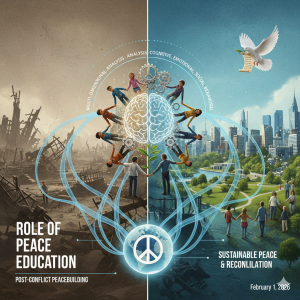
Role of Peace Education in Post-Conflict Peacebuilding: A Multi-Dimensional Analysis

Prof. Said Abubakar, Febrruary,1, 2026

The scholarly literature consistently underscores the indispensable function of peace education as a foundational pillar for sustainable peacebuilding in societies emerging from violent conflict. This commentary synthesizes key theoretical and empirical insights, arguing that education operates not as a singular intervention but as a multi-faceted ecosystem crucial for reconciliation, social reconstruction, and the prevention of conflict relapse.

A primary contribution of peace education is its capacity to navigate the complex interplay between justice and reconciliation. As Pankhurst (1999) elucidates, post-conflict periods are characterized by “complex political emergencies” where the pursuit of justice and the need for societal healing must be carefully balanced. While formal judicial mechanisms, often supported by external actors, address accountability, reconciliation is fundamentally an endogenous process. International actors thus play a supportive, rather than directive, role in fostering the conditions for internal healing (Pankhurst, 1999). Education systems become critical spaces where this support is operationalized, helping to process collective trauma and foster a shared narrative.

In the practical task of reconstructing a shattered civil society, education is the primary vehicle for instilling the norms essential for a democratic and peaceful polity. Davies (2004) argues that post-conflict education must transcend basic literacy to actively “build a civic culture” through deliberate instruction in legal awareness, human rights, and citizenship. These educational domains are instrumental in rebuilding eroded trust, fostering participatory governance, and promoting social accountability—cornerstones without which a technical peace agreement remains fragile (Davies, 2004). This aligns with the critical question posed by Carr and Porfilio (2012), who challenge the assumption that education is inherently a force for good. They contend that in contexts of conflict, educational institutions and their curricula can either perpetuate divisive ideologies or serve as transformative platforms for peace, depending on their design and implementation (Carr & Porfilio, 2012).

The transformative potential of education is significantly amplified when it actively includes marginalized voices. Mojab’s (2008) analysis emphasizes the pivotal, yet often overlooked, role of women’s learning and knowledge in conflict prevention and peacebuilding. Inclusive educational research and practice that centralize the experiences of women and other marginalized groups are vital for developing holistic and effective peacebuilding strategies (Mojab, 2008). This is empirically demonstrated in the post-conflict context of Bosnia and Herzegovina, where Jelešković and Mulalić (2022) document how female academics act as key agents in peacebuilding and state-building. Through their academic work and societal engagement, these professionals advance gender-sensitive approaches and promote social cohesion, thereby addressing structural inequalities that fuel conflict (Jelešković & Mulalić, 2022).

Beyond formal schooling, the ecosystem of peace education includes higher education and civil society. A case study from Khyber Pakhtunkhwa illustrates that strategic policy in higher education can directly contribute to violence reduction. Shahab and Ullah (2021) found that expanding access to higher education and aligning its goals with community peacebuilding enabled youth to engage in productive civic life, acting as a “catalyst for peace” (Shahab & Ullah, 2021). Furthermore, non-governmental organizations (NGOs) fill crucial gaps in this ecosystem. As Carey (2017) discusses, NGOs often act as subcontractors of peace, implementing on-the-ground initiatives for social stabilization, community dialogue, trauma management, and local institution-building—functions essential for translating national-level peace into local reality (Carey, 2017).

Based on the synthesized literature, actionable recommendations for Somalia to leverage peace education as a catalyst for sustainable peacebuilding include several interconnected strategies. First, the Federal Ministry of Education, Culture & Higher Education should collaborate with regional states to revise national curricula from primary to secondary levels, incorporating mandatory, context-specific modules on peacebuilding, human rights, civic education, and conflict resolution. This initiative aligns with Davies (2004), who emphasizes the need for formal education to move beyond rote learning and actively foster democratic values and a shared Somali civic identity. Second, it is crucial to empower higher education institutions by establishing “Peace and Social Cohesion” departments in universities to conduct applied research on local conflict drivers and engage in community outreach programs,. Third, Somalia should systematically support female educators and academics by launching targeted scholarships and leadership training, thus leveraging their unique community standing in peacebuilding efforts, as observed in Bosnia and Herzegovina (Jelešković & Mulalić, 2022). Additionally, establishing formal partnerships with NGOs through a clear accreditation framework would enhance the coordination of community-based peace education efforts, ensuring they align with national educational goals and facilitate social stabilization (Carey, 2017). Moreover, forming a high-level, cross-sectoral national commission that includes educators, traditional elders, youth, and women’s representatives will help oversee the implementation of peace education strategies and ensure they are culturally legitimate, addressing local conceptions of justice and healing (Pankhurst, 1999). Finally, investing in teacher training and professional development focused on peace pedagogy is essential for transforming teachers into active facilitators of peace, thereby ensuring that even well-designed curricula are effectively implemented (Carr & Porfilio, 2012). By adopting these recommendations, Somalia can harness its education system—from primary schools to universities, in partnership with civil society—to rebuild social trust, empower its citizens, and cultivate the foundational civic culture necessary for lasting peace.

References

Carey, H. F. (2017). Subcontracting peace: The challenges of NGO peacebuilding. Journal of Peacebuilding & Development, 12(2), 1-15. https://doi.org/10.1080/15423166.2017.1328142

Carr, P. R., & Porfilio, B. J. (Eds.). (2012). Educating for peace in a time of permanent war: Are schools part of the solution or the problem? Routledge.

Davies, L. (2004). Building a civic culture post-conflict. London Review of Education, 2(3), 229-244. https://doi.org/10.1080/1474846042000302837

Jelešković, E., & Mulalić, A. (2022). Female academics’ role in peace-building, state-building and gender equality in Bosnia and Herzegovina. Epiphany, 15(1), 68-84. https://doi.org/10.21533/epiphany.v15i1.386

Mojab, S. (2008). Women, war and learning. International Feminist Journal of Politics, 10(3), 382-387. https://doi.org/10.1080/14616740802185674

Pankhurst, D. (1999). Issues of justice and reconciliation in complex political emergencies: Conceptualising reconciliation, justice and peace. Third World Quarterly, 20(1), 239-256. https://doi.org/10.1080/01436599914013

Shahab, S., & Ullah, S. (2021). The role of higher education as a catalyst of peacebuilding in conflict affected regions: The case study of Khyber Pakhtunkhwa after FATA amalgamation. Journal of Peace Education, 18(3), 334-354. https://doi.org/10.1080/17400201.2021.1980365


.

January 31 2026

 The Role of Environmental Education in Somalia’s Recovery and Development

Prof. Said Abubakar

Somalia’s transition toward stability and sustainable development cannot be separated from its ecological future. As a nation emerging from decades of conflict, Somalia faces intertwined challenges: environmental degradation, climate vulnerability, resource scarcity, and weakened governance. In this context, environmental education (EE) is not merely an academic subject but a foundational strategy for peacebuilding, resilience, and sustainable recovery.

Why Environmental Education is Vital for Somalia

Environmental education is vital for Somalia because it addresses the interconnected challenges of environmental degradation, climate vulnerability, and post-conflict recovery. By fostering an understanding of ecological systems and sustainable practices, environmental education equips Somali communities with the knowledge and tools needed to manage natural resources cooperatively, mitigate climate risks, and rebuild social cohesion. This approach not only promotes environmental stewardship but also supports broader goals of peace, stability, and long-term development.

Key Gaps in Current Strategies

Despite promising initiatives, several gaps limit the impact of environmental education in Somalia. Programs are often fragmented, underfunded, and poorly coordinated between NGOs, government, and local communities. Environmental education remains marginal in national curricula, teacher training, and school infrastructure, reducing its reach and sustainability. Many initiatives are externally driven, which limits community ownership and relevance, while indigenous ecological knowledge is frequently overlooked. Additionally, weak monitoring and evaluation mechanisms fail to capture long-term behavioral or ecological impacts, hindering the ability to adapt and scale effective interventions.

Actionable Recommendations

To maximize the potential of environmental education in Somalia, a coordinated and context-sensitive approach is essential. First, environmental education should be integrated into national education policy through a formalized, cross-cutting curriculum for primary and secondary schools, supported by locally relevant teaching materials. Second, investing in teacher training and school green infrastructure—such as gardens and water-harvesting systems—can enhance practical learning. Third, programs must center community knowledge and participation by involving local leaders, farmers, and women’s groups in design and implementation. Given infrastructural constraints, digital and radio-based learning should be leveraged to reach remote and displaced populations. Strengthening partnerships through a Somalia Environmental Education Network can improve coordination and resource mobilization. Monitoring should shift toward community-defined indicators that track behavioral change, ecosystem health, and social cohesion. Finally, linking environmental education to livelihood opportunities—such as sustainable agriculture, renewable energy, and ecotourism—can create green jobs and foster youth entrepreneurship, ensuring that education translates into tangible economic and environmental benefits.

Conclusion

Environmental education in Somalia is a catalyst for holistic recovery—connecting ecological health with social stability, economic opportunity, and intergenerational justice. By adopting a strategic, inclusive, and context-sensitive approach, Somalia can transform environmental challenges into platforms for community empowerment, peace, and sustainable development. The time to invest in EE is now: not as an optional add-on, but as a core pillar of Somalia’s post-conflict rebuilding agenda.